
The Arena
The space between “no” and leaving

As he approached my vehicle, I first noticed his big smile and felt welcomed by his open energy. He began talking before I could hear him. I couldn’t get out of my car without pushing him aside with the door. After shaking his hand, I slipped past him to hug my friend.
The man continued talking as we unloaded the horses from the trailer and entered the perfectly groomed arena. He invited us to free the horses to explore and roll in the sand if they were inclined. Instead, they combed the perimeter, the younger horse mouthing and then sending every broom and pitchfork lining the arena clattering to the ground.
After half an hour, I realized the orientation had morphed into an unending monologue about this man’s accomplishments. I found small pockets of relief in the breaks—when I stepped away to right the tools.
As the clock ticked toward an hour, I felt the energy draining from my body. My enthusiasm soured into strategy. How do I exit this conversation?
I began directing my attention toward the horse I was working with, Garbanzo. I positioned his massive body between myself and the man. There was work to do before it would be safe to ride. The man turned toward my friend’s captive gaze. Continued talking.
Tension crept up my spine and settled at the base of my skull. I was divided. On the one hand, we were on his turf. I wanted to give him the benefit of the doubt. I wondered if there was something I didn’t understand—something that might explain the way he moved through the interaction. I also felt the pull to be kind. To be generous with my time. To not make something out of nothing.
And yet, something in me was tightening.
Not loudly. Not dramatically. But steadily.
A quiet sense that I was no longer choosing to be in this interaction.
I escalated my avoidance strategy, asked directly for help from my friend to extract her from his sphere.
When he finally left us alone, we both drooped forward and exhaled. Then raised our eyes and took each other in.
“That was a lot,” I mouthed.
We mounted our horses and walked side by side, taking deep breaths with long, audible exhales. I felt the saddle beneath me, listened to the birds, and hoped the act of riding would settle whatever had been stirred.
When I asked Garbanzo to move up in gait, he thrust his head toward the ground and bucked repeatedly.
Assuming it was a fluke, I redirected him and asked again.
The bucking continued.
I knew something was off.
“I hear you, Garbanzo,” I said, patting his neck. I wanted him to know I was listening—that I wouldn’t make the same request again until we figured it out. Maybe the saddle was hurting his back. Maybe the cinch was pinching his belly. Either way, something wasn’t right.
My friend and I ended our ride and dismounted.
Later that evening, recounting the experience, I noticed a low, simmering charge beneath the surface of my body. Not quite anger. Not quite clarity. Something unresolved.
The next morning in therapy, my attention drifted to another memory.
I was six years old, on horseback, sharing a lesson with an older boy. I was riding a small grey pony—Little Grey—who was stubborn and difficult to steer. At one point, I crossed in front of the boy, apparently too close.
Exasperated, he yelled to my trainer,
“Can’t I just RUN HER OVER?”
I remember stopping in the center of the arena. Shrinking in the saddle. Even though my trainer spoke up for me, something landed deeper than the moment itself.
A quiet, internal conclusion:
I don’t matter.
Standing in the present-day arena, I could feel the echo of that same pattern.
How quickly I move to accommodate.
How readily I override my own signals.
How much space I give before I even register that I’ve lost it.
At first, I registered the man as friendly. Maybe a little eager.
Then something in me tightened—so subtly I almost missed it.
It wasn’t one thing.
It was proximity. The way he stood too close.
The way the conversation didn’t quite track.
A comment that landed wrong in my body before my mind could organize it.
I’ve spent a lot of my life overriding that kind of data.
What I felt in the arena wasn’t a single, definable event. It was a gradual loss of choice. A sense that I was staying in something I was no longer actively choosing.
And what unsettled me most wasn’t the interaction itself—but how long it took me to respond to it.
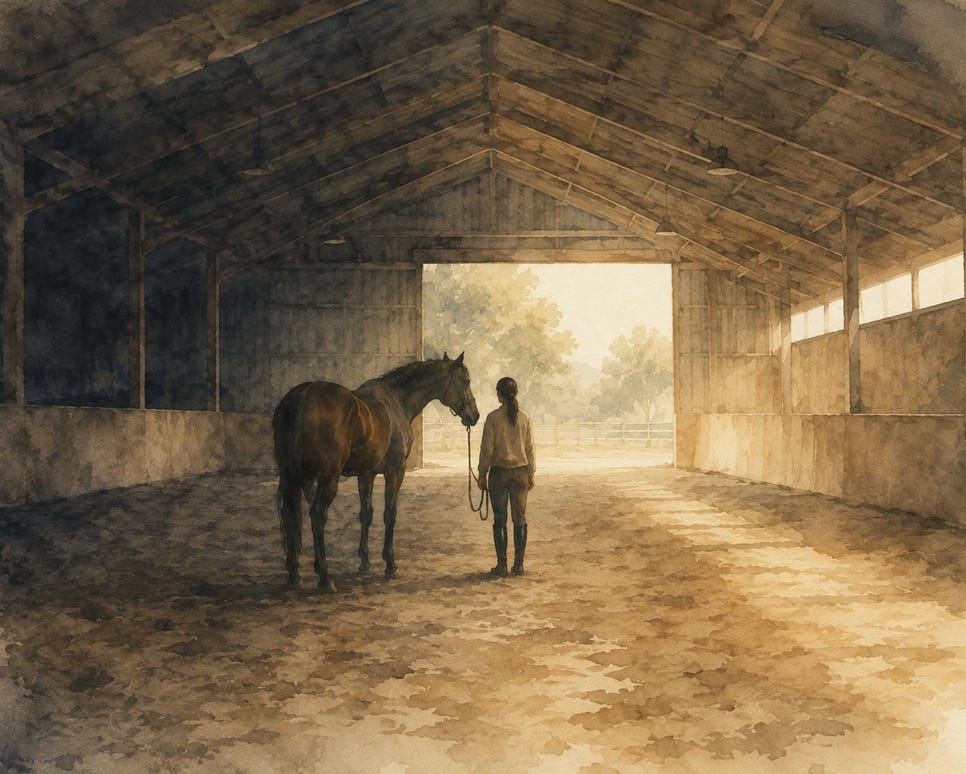
I noticed how quickly I responded to Garbanzo when something was off.
No second-guessing.
No wondering what it meant about him.
No internal debate about whether he deserved more time, more patience, more understanding.
Just a simple recognition:
Something isn’t right.
And a willingness to adjust.
I wonder what it would be like to offer myself the same.
To feel the signal and respond before the story rushes in.
Before politeness, or empathy, or obligation begin negotiating on someone else’s behalf.
I imagine returning to the arena and noticing sooner.
Creating space without apology.
Ending the conversation before my body has to speak any louder.
Not because I understand him better.
But because I’m finally learning to listen to myself.
✊🏼✊🏼✊🏼
This has happened to me so many times. What causes us to be so accommodating? That's not being nice to ourselves.